Living Places Institute ←  Deep Story
Living Places Institute · Story of Place · The Canberra Basin

The Queen and the Capital

The relationship between Queanbeyan and Canberra
12 minutes 33 seconds · Queanbeyan and CanberraWatch on YouTube

Long before this tale, others knew every stone of this country, every bend of the river and every song of the seasons on the plain. This tale does not tell their story. It is not ours to tell.

At the head of the table it keeps an old chair. The chair stays empty until they choose to sit.

The characters are invented. The Queen stands for the town at the crossing, not for any real person. In this basin, colonists gave the titles "King" and "Queen" to Aboriginal people. This tale does not draw on those titles or the people who carried them.
The story, part by part

Every scene stands on something that happened

The tale follows the twelve stages of the hero's journey. Under each part is the record it was built from, and where the tale bends it.

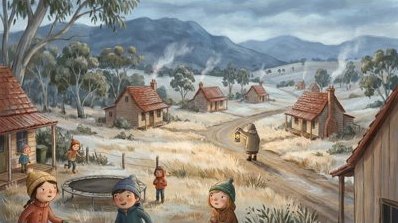
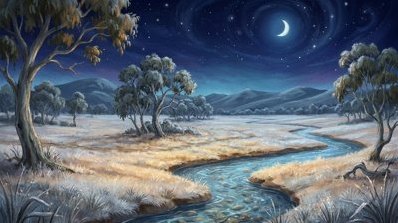
A frosted river plain under a crescent moon
Before

The clear water

In the tale

A river so clear you could count the stones on its bed and see your own true face.

In the record

  • The town's name is said to come from Kuwinbiyan or Quinbean, given as a Ngarigo word for "clear waters". The meaning is not settled.
  • The crossing sits where several Countries meet. Ngambri, Ngunnawal, Ngarigo and Walgalu connections are claimed, and recognition is contested.
  • The ACT recognises the Ngunnawal and, since its April 2023 apology to Ngambri plaintiffs, acknowledges other claims. The tale does not settle this. It keeps the chair open.
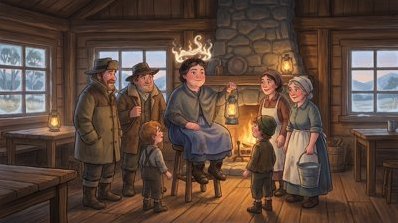
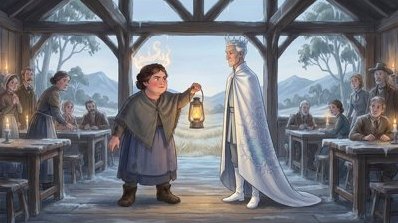
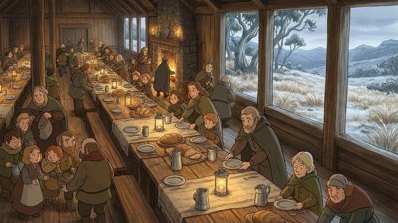
The Queen with her lantern and crown of smoke in a crowded inn
I · The ordinary world

The lantern that would not go out

In the tale

A former convict sets his lantern down on the river flat without leave. Travellers stop. A town grows around the light, and becomes the Queen of the Crossing. Her throne is a pub stool.

In the record

  • 1828: Timothy Beard, an ex-convict innkeeper from Campbelltown, squats illegally at "Quinbean" on the Molonglo, near today's Oaks Estate.
  • 1836: a post office opens. 1837: Captain Alured Tasker Faunce is appointed police magistrate.
  • 1838: the township is proclaimed, with about 50 people. Surveyor James Larmer lays out the town plan.
A glowing city appears over the moonlit plain
II · The call

The dreamer and the city that wasn't there

In the tale

Mills turn, gold winks in the hills and bushrangers ride. On a Christmas morning a young man sees a city standing on the empty grass. "It is waiting to be called."

In the record

  • 1840s to 1870s: the bushranger era, including William Westwood (Jacky Jacky), Frank Gardiner and Ben Hall. 1851: gold traces are found.
  • At its rural peak the town had 16 pubs and six flour mills.
  • Christmas Day 1855: John Gale rides across the Limestone Plains and later calls it a "prophetic inspiration": "What a magnificent site for one of Australia's future cities!"

Gale saw a future city. The tale makes it the capital, which is what he spent his life campaigning for.

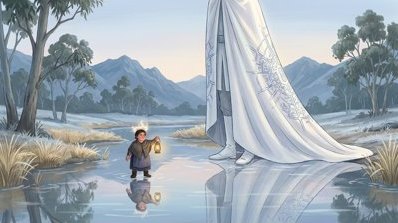
The small Queen sees a towering figure reflected in the river
III · The doubt

The warning in the water

In the tale

The river shows her two faces: swallowed beside a king, or alone while the nation passes by. "I will call as a Queen, and never as a servant."

In the record

  • This scene is not a dated event. It carries a fear residents still name today: being swallowed by Canberra.
  • The same fear runs through the 1911 vote, both councils opposing the 2016 merger, Bungendore's worry about becoming a "satellite town" and rural residents calling council "city-centric".
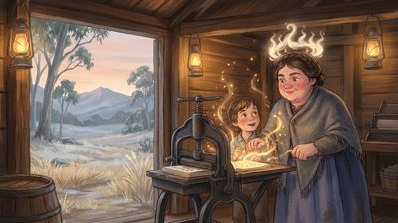
The Queen and a young man at a printing press
IV · The mentor

The spell of the printed word

In the tale

The dreamer builds a printing press and writes for fifty years. A snow-country town is chosen first. Then he reads his strongest spell: "Dalgety or Canberra, Which?"

In the record

  • 15 September 1860: Gale prints the first issue of The Golden Age, the district's first newspaper. It became the Queanbeyan Age in 1864.
  • 11 June 1900: Gale and 11 locals give evidence for a Queanbeyan and Canberra site.
  • 1904: Dalgety, in the Snowy country, is chosen first.
  • 24 July 1907: Gale reads "Dalgety or Canberra, Which?" at a public meeting in Queanbeyan. Sir John Forrest later credited it with changing his vote.
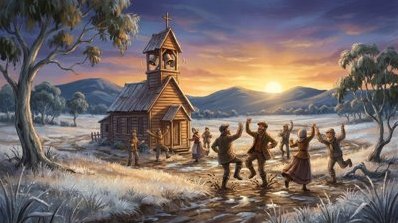
People dancing outside a small church at dusk
V · Crossing the threshold

The day the bells rang

In the tale

The word comes down: the capital will wake on the Queen's plain. Her people dance. She feels the ground hum, and knows it cannot be put back to sleep.

In the record

  • 1908: the Yass-Canberra district is chosen as the site of the national capital, over Dalgety.
The Queen faces the silk King in her hall
VI · The proposal

I did not call to disappear

In the tale

The King steps out of a painting on fourteen panels of linen and silk. A lady speaks his name on a hill. He asks the Queen to marry him and join his kingdom. Her people answer: No.

In the record

  • 1912: Walter Burley Griffin wins the world design competition. Marion Mahony Griffin rendered the plan on 14 linen and silk panels, but the credit went to Walter.
  • 12 March 1913: Lady Denman names the city Canberra on Kurrajong Hill.
  • About 1.2 million trees were planted under Charles Weston between 1913 and 1926. Territory land has been leasehold, not freehold, since 1910.
  • 1911: Queanbeyan residents vote by a wide margin not to join the Federal Capital Territory.

The tale moves the 1911 vote to after Canberra is drawn and named. In fact the town said no first.

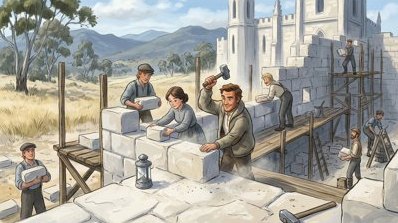
Workers building white stone walls
VII · Tests, allies and enemies

The dry spell and the badge of struggle

In the tale

The King bans drink, so his builders cross the line for beer and jazz. Newcomers from across the oceans build his palaces. His courtiers sneer "Struggletown". She pins the word to her coat like a medal.

In the record

  • 1911 to 1928: Canberra is dry, and Queanbeyan becomes its pub. The Royal Hotel (1926) and Hotel Queanbeyan date from this time.
  • 1920s: rules requiring Canberra workers to live in Canberra hurt the town.
  • 1950s: temporary housing for post-war migrants who "worked hard and helped build the city". Historian Nichole Overall calls "Struggletown" a badge of honour.
  • Trades workers are still 13.3% of employed residents in the region, against 9.6% in the ACT (2021 Census).
  • Champions: Heather McKay (16 straight British Opens), David Campese (64 Test tries), Ricky Stuart (coached NSW and Australia), Mark Webber (nine Grand Prix wins).
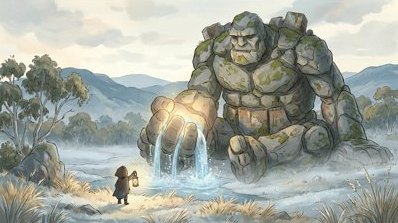
A stone giant holds the spring in its fist
VIII · The inmost cave

The stone giant and the spring

In the tale

The thirsty King sends a stone giant up the Queen's river to hold the spring. "You hold my water now." "I hold it for both of us."

In the record

  • 1979: Googong Dam is completed on the Queanbeyan River, upstream of the town. It is Commonwealth-owned and run by Icon Water, and it supplies both Canberra and Queanbeyan.
  • The Molonglo through Canberra was dammed into Lake Burley Griffin at Scrivener Dam in the 1960s.
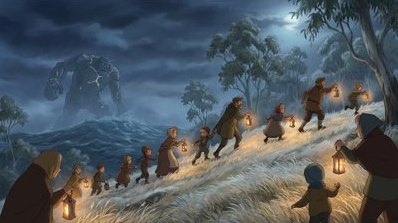
People with lanterns flee uphill in a storm
IX · The ordeal

The night the river forgot her name

In the tale

The river breaks into her cemetery and carries the dead away. Two years later it rises again, and five thousand people run in the dark. The giant holds.

In the record

  • 1974: a major flood tears into Riverside Cemetery, hitting about 100 graves.
  • October 1976: the river peaks 15 cm below 1974. About 5,000 people are evacuated as the unfinished Googong Dam is threatened.
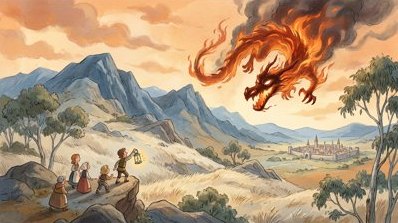
A fire dragon flies over the hills toward a city
X · The reward

Fire, and the thread of water

In the tale

A red dragon of fire bursts into the King's city. The Queen does not gloat. She sees the silver thread of water that ties them: whatever she pours in, he drinks.

In the record

  • 18 January 2003: bushfires enter Canberra from the west. Four people die and more than 500 homes are destroyed or badly damaged.
  • The two cities share one water system. Canberra's water authority runs the dam above Queanbeyan, and Queanbeyan's 1930s sewage plant discharges toward Canberra's lake.
  • Mayor Kenrick Winchester (2026): "Queanbeyan is so good they build the capital of the country next door."
New houses and children in the paddocks
XI · The road back

The wild cousins of the east

In the tale

Without asking, the great council binds the Queen to her wild cousins. New towns spring up like mushrooms. Builders bring plans for towers. Her people answer: "We're not becoming a cityscape."

In the record

  • 12 May 2016: Queanbeyan City is merged with Palerang into Queanbeyan-Palerang Regional Council. Both councils opposed it.
  • The cousins: the Araluen and Majors Creek goldfields, Braidwood (heritage-listed as a whole town), Lake George, the Monga forest and Captains Flat, where lead was still found in public areas in 2021.
  • New towns: Googong (first residents 2014) and a fast-growing Bungendore, which went from 4,765 to 7,664 people between 2021 and 2024.
  • October 2026: a draft infill housing strategy goes on exhibition. The general manager rules out 15-storey blocks: "We're not becoming a cityscape."
A long table set in the hall with the chair at its head
XII · The resurrection

The empty chair

In the tale

She lays the longest table and calls everyone, even the King. Then she understands the old chair at its head. She was not the first sovereign of this place. She leaves it open, bows, and waits.

In the record

  • Country and its custodians come before both cities. Recognition here is still contested and unresolved.
  • This part is held as a protocol, not a fact. The story the chair stands for belongs to its custodians to tell.
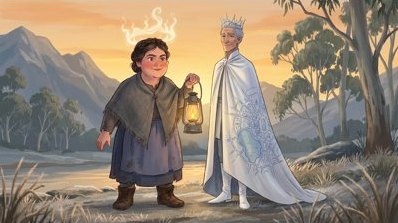
The Queen and the King stand side by side by the river
XIII · The return with the gift

The tension is the gift

In the tale

They will never be one. He plans; she remembers. He was drawn on silk; she was worn into the ground. Each has made the other, the way a river and its bank shape each other.

In the record

  • About 18,500 residents of the region commute into the ACT, and about 5,000 travel the other way.
  • Queanbeyan's trades helped build Canberra. Canberra's jobs, water management and services sustain Queanbeyan.
  • The river carries both towns' water into the Murrumbidgee, and from there into the Murray and out to the sea.
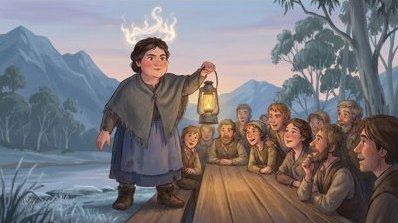
The Queen raises her lantern over the table of townspeople
The open ending

Where do we go next?

In the tale

The tale stops. The next part has not happened yet. The Queen sets her lantern in the middle of the table and asks the people of the crossing.

In the record

  • The region's population was 65,369 in 2024. Council forecasts about 85,000 by 2041.
  • Water, sewage capacity and cross-border roads now set the limits on growth.
The lantern is still burning

About the facts

The tale is invented. The events under each part come from Veridian research briefs of 31 October 2026, which cite the public sources listed here. Where sources disagree, or where the tale changes the order of events, this page says so.

If you know this history and see something wrong or missing, tell us. Every reading of this place is offered for correction by the people it describes.

Sources